


Authorship on Content Best Practice
This article investigates the Importance of Authorship on Content Articles, focusing on the advantages of author bios and author pages.
Author biographies
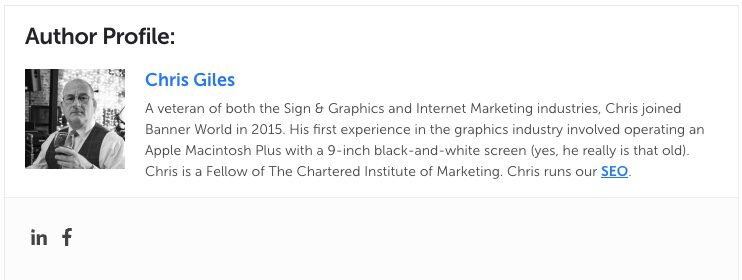
An author bio is a concise paragraph-length piece that introduces an author and summarises their work and credentials. It is often placed beneath blog posts or news information, with connections to further content created by the author.
Author pages
Author pages are dedicated URLs that include all of the author’s material. This page’s content generally builds on the author’s credentials and qualifications.
Although Google does not consider author pages to be ranking criteria, author bios are part of the common standards that quality raters look at to validate a website’s quality.
We’ll look at why search engines like Google think author biographies are a good sign of content quality, how they affect website rankings, and how to construct optimised author bios for your website.
Author authority and Google
Google’s Quality Raters Guidelines provide guidance on how to rank higher in Google. According to these standards, naming a blog or article author and displaying their biography and qualifications is a technical need to check off the SEO ranking signal list.
However, Google’s John Mueller downplayed the importance of author pages for SEO in 2019. He claims that they assist search engines have more trust in the author’s identity and “promote authors in search results,” but that they are more for user experience.
Author bylines and author biographies were mentioned in that statement as crucial methods to establish confidence; and in a 2021 SEO webinar for publishers, Google Search Liaison Danny Sullivan emphasised the necessity of having a distinct byline, not “By staff,” for openness.
Although Google’s stated position is that author biographies are not a ranking criteria, there is an advantage to having distinct bylines and material displaying competence on an author’s bio page. It will only help Google’s algorithms grasp the author’s E-A-T. As a result, the ranks of such articles in search results may improve.
In conclusion, author biographies may help readers create trust, and visitors who trust your site are more likely to promote your material to others. This might boost the credibility of your article.
While an author page is not a ranking factor, it may enhance your ranking and traffic indirectly.
Best practice for creating author bios
When you publish a blog article on the internet, you must provide credit to the author. An author bio that connects to an author page is a terrific opportunity for some extra SEO value, and it’s one that far too many people overlook. Such, how can you optimise an author bio so that it adds value to your entire site?
Keep it brief & to the point
A decent author biography should be brief. If you look around on other websites, you’ll see that most author profiles online are between 50 and 100 words long.
Consider any space constraints imposed by the CMS.
Write it in the third person
Writing in the third person boosts perceived authority and reads better than a biography written about oneself. It may appear self-congratulatory, but it adds credibility.
Include a job title & job function
Include information about the author’s work and role in a way that provides credibility and authority to their writing. Consider a more authoritative approach to describe what the author performs; for example, instead of a blog writer, they may become a Content Strategist.
When reading an author bio, function is also significant since it adds additional relevant expertise.
Include experience, qualifications & credentials
Not only is stating expertise in the author bio vital for SEO, but it also helps users recognise you as a reliable source on a given topic area.
It is critical in the health and financial sectors, in particular, to exhibit knowledge and skill in their respective fields. As disinformation has the potential to cause substantial harm, they are referred to as Your Money, Your Life (YMYL).
Include expertise and qualifications that demonstrate why readers should pay attention to the author. What have they done that deserves to be mentioned? Years of experience, credentials, media attention, previous positions, published works, or citations are all examples.
Include a photo
Including a photograph of the author in your bio is a terrific visual method to inform the reader that there is a real person behind the words they have read.
For optimum effect, the author should send the identical image to each newspaper for which they write, as well as to each of their social media accounts and public pages that represent them. Most individuals who read their article won’t remember their name, but they will remember their face.
Include links to an author’s social media profiles
Include a statement indicating where else the author’s work may be located. Including connections to social media in author biographies allows viewers to obtain more material from the author by linking to their personal or company website, as well as their social media profiles.
Links to social media accounts can also assist readers identify social media handles to tag the author and/or your brand in their posts, as well as a way for readers to continue the conversation.
Things to avoid
Unprofessional tone
It’s generally not a good idea to provide too much personal details in an author bio. While adding personality to a bio may help it become more engaging, emphasising uniqueness and humour too much can be off-putting and detract from the authority the bio is designed to represent.
Fake authors
It is best to avoid creating a fictitious figure to represent an author. Mostly because the bio will ultimately be retired, and the site will no longer be able to capitalise on the in-person value of that reputation.
Using ‘staff’ or ‘team’ as the author
Google has emphasised the significance of openness in author biographies, emphasising the necessity of having a distinct byline rather than “By staff.”
Best practice for optimising
We can now look at how to optimise this information on your website to improve SEO performance after developing a captivating author bio. In this section, we’ll look at the technical elements of adding an author bio to your website.
Use dedicated URLs
It is far easier to optimise an author page on a distinct URL for author names than it is to include all writers on a single about us page.
Having an author page for each author allows people to better recognise them and develops their authoritative voice. In the competitive digital scene, being a recognised person is critical, and having a well-structured author page is a sure-fire method to stand out and be viewed as an expert.
Use schema structured data mark-up
Schema.org is a sort of structured data used by Google and other search engines to extract additional value from specific pieces of content. It enables you to identify the real author of a post rather than relying on search engines to do so based on the structure of your site.
Google has revised its ‘Article’ structured data, and it now suggests including the author’s URL in the article schema. Schema types to add to a profile include ‘worksFor’, ‘alumniOf’, ‘sameAs’.
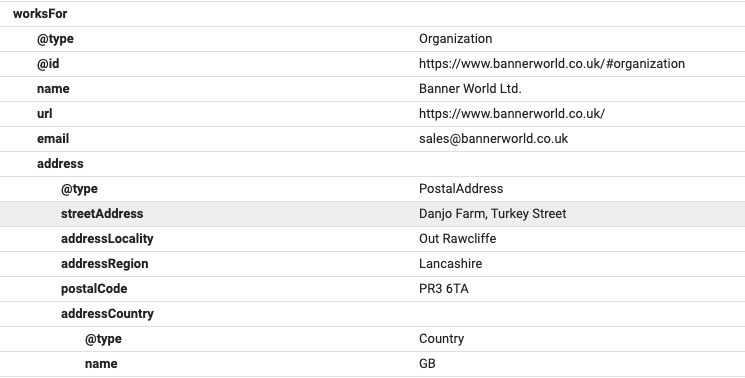
Using structured data may also benefit E-A-T by allowing Google to make new connections in its Knowledge Graph that it would not have established otherwise.
Ensure author pages are indexed
It is a prevalent misperception that author pages should not be indexed.
Some argue that some profile pages are low quality and exploited for link spam, and that you should no-index them.
However, if author pages are created appropriately with readers in mind, and writers have competence in the subject matter, indexing and optimising them is a no-brainer.
Consider page hierarchy & internal links
There should be connections to author profile pages on the article detail pages via the byline for each item generated.

Chris Giles Snr built his first client website in 1995 and has remained at the leading edge of web development and SEO ever since. He is a Fellow of The Chartered Institute of Marketing (FCIM).