

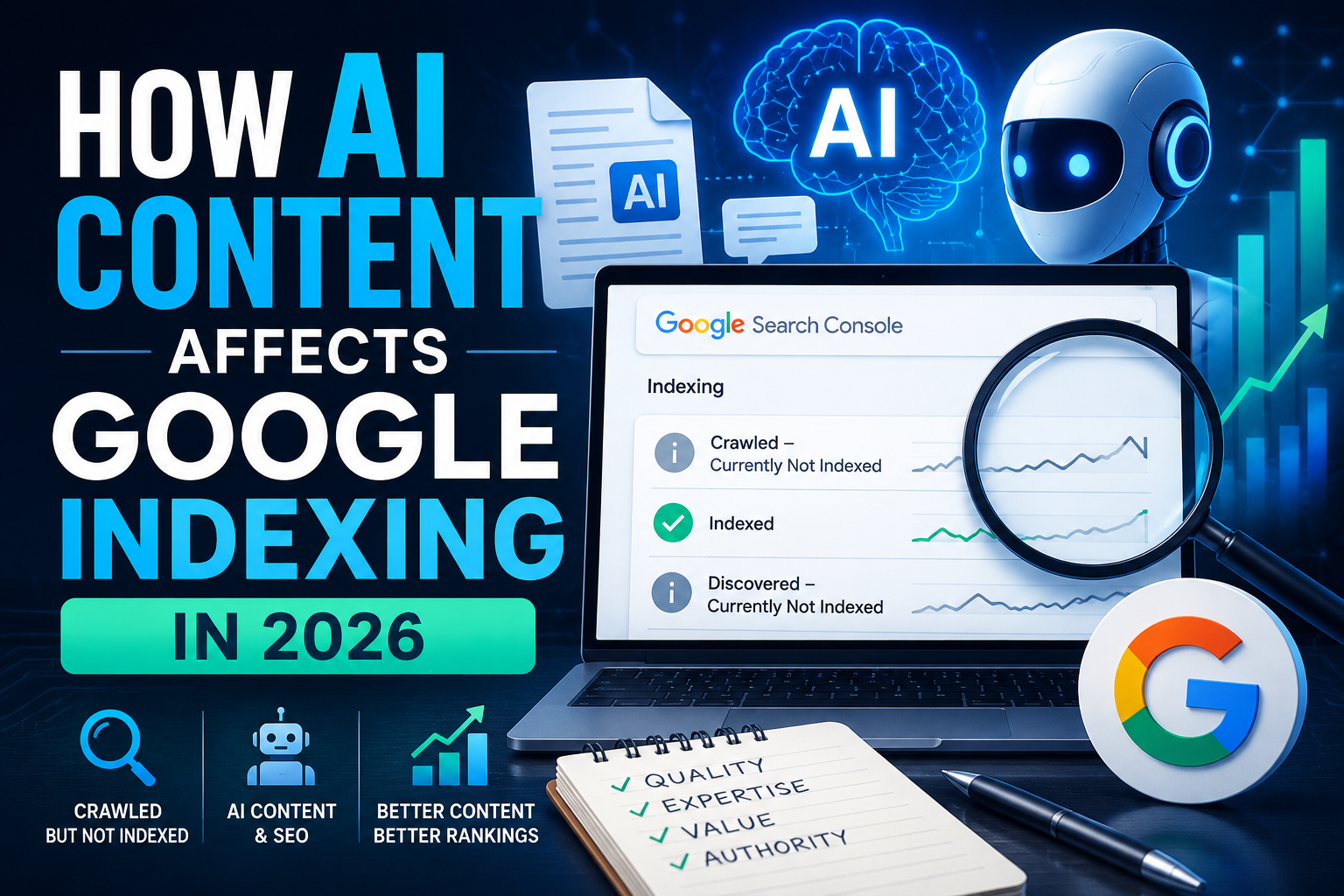
AI-generated content has changed the way many businesses create blogs, service pages, product descriptions and SEO content. It can speed up research, planning and writing, but it can also create serious indexing problems when used badly.
One of the biggest misconceptions is that publishing content automatically means Google will index it. That is not true. Google may crawl a page, process it and still decide not to include it in search results.
This is why many websites now see more pages sitting in Google Search Console under statuses such as Crawled – Currently Not Indexed or Discovered – Currently Not Indexed.
AI content itself is not the problem. Low-quality, generic, repetitive or mass-produced content is the problem. In 2026, Google is far more selective about what it indexes.
Does Google Penalise AI Content?
Google does not automatically penalise content just because AI was used to help create it.
Google’s own guidance focuses on whether content is helpful, reliable and created for people. The issue is not whether AI was involved. The issue is whether the final page provides genuine value.
AI-assisted content can perform well when it is:
- useful
- accurate
- original
- expert-reviewed
- well-structured
- created to satisfy real search intent
However, AI content becomes risky when it is used to generate large numbers of low-value pages, mainly to manipulate search rankings. Google refers to this type of behaviour as scaled content abuse.
What Is Scaled Content Abuse?
Scaled content abuse occurs when many pages are created primarily to manipulate search rankings rather than to help users.
This can involve AI tools, automation, scraping, spinning, templating or even human-written content produced at scale with little originality.
Examples include:
- hundreds of near-identical local landing pages
- mass AI-generated blog posts with no expert input
- thin affiliate pages created only to rank
- rewritten versions of competitor articles
- pages generated for every possible keyword variation
- content that summarises other pages without adding anything new
This matters because Google does not need to index every page it finds. If a page looks generic, repetitive, or low-value, Google may simply ignore it.
How AI Content Affects Google Indexing
AI content can affect indexing in several ways.
If the content is strong, useful and clearly connected to your website’s expertise, it can help you build topical authority and increase search visibility.
If the content is weak, generic or published at scale without quality control, it can make Google less likely to index those pages. In some cases, a large amount of low-value content can also reduce the website’s overall perceived quality.
Google’s systems look for signs that a page deserves to be indexed, such as:
- unique information
- clear search intent match
- helpful structure
- original examples or insight
- trustworthy content
- internal links from relevant pages
- evidence of expertise
AI can help create content, but it cannot replace the need for judgment, experience and proper SEO strategy.
Why AI Pages Often Fail to Index
Many AI-generated pages fail to be indexed because they do not provide Google with a strong enough reason to include them in search results.
Common reasons include:
- Thin content: The page is too shallow and does not answer the topic properly.
- Generic wording: The article sounds like many other AI-written pages online.
- No original value: The content repeats common information without adding examples, experience or insight.
- Poor internal linking: The page is not linked from other important pages on the site.
- Weak topical authority: The website does not yet have enough supporting content around the subject.
- Duplicate intent: The page overlaps too closely with other pages on the same website.
- Mass publishing: Too many pages are published too quickly without proper editorial control.
When these issues are present, Google may crawl the page but exclude it from the index.
AI Content and “Crawled – Currently Not Indexed”
AI content is often linked to the Crawled – Currently Not Indexed status in Google Search Console.
This status means Google has visited the page but has chosen not to index it at that time.
For AI-assisted content, this usually happens when Google does not see enough value, originality or importance in the page.
For example, a blog post generated from a basic prompt may look complete at first glance, but if it contains the same explanations already found across hundreds of websites, Google may not consider it worth indexing.
If you are seeing this issue regularly, read our full guide on Crawled – Currently Not Indexed in Google Search Console.
AI Content and “Discovered – Currently Not Indexed”
Discovered – Currently Not Indexed is slightly different.
This means Google knows the URL exists but has not yet crawled it.
AI content can contribute to this issue when a website publishes too many new URLs too quickly. If Google does not view the site as authoritative enough, or if many pages look low-value, it may delay crawling them.
This is especially common with websites that generate lots of:
- AI-written location pages
- AI-written product descriptions
- AI blog posts targeting very similar questions
- programmatic SEO pages
- low-value category or tag pages
The more pages you publish, the more important quality control becomes.
Does AI Content Help or Hurt SEO?
AI content can help with SEO when used properly.
It can support:
- content planning
- topic research
- outline creation
- FAQ development
- content expansion
- rewriting unclear copy
- improving structure
But AI content can hurt SEO when it replaces proper thinking, expertise and quality control.
The difference is simple:
- Good use of AI: AI assists the content process, but a human improves, checks and adds value.
- Bad use of AI: AI produces large volumes of generic content with little review or originality.
Google does not need more average content. It needs content that is genuinely useful to searchers.
What Type of AI Content Usually Performs Poorly?
AI content usually performs poorly when it is created mainly to fill a content calendar or target keywords without adding anything new.
Examples include:
- generic “what is” articles with no unique insight
- repetitive local landing pages
- service pages where only the town name changes
- thin comparison posts
- AI-written affiliate content
- articles copied from competitor structures
- content with no examples, evidence or real-world experience
These pages often struggle because they do not demonstrate enough value, trust or originality.
What Type of AI Content Can Perform Well?
AI-assisted content can perform well when it is properly planned, edited and improved.
Stronger AI-assisted content usually includes:
- clear search intent targeting
- expert review
- specific examples
- original commentary
- local or industry context
- internal links to relevant pages
- accurate facts
- helpful FAQs
- structured headings
- a clear reason to exist
For example, an AI-assisted article about SEO for local businesses will be much stronger if it includes real examples for accountants, electricians, plumbers, builders or estate agents rather than generic advice that could apply to anyone.
How to Improve AI Content So Google Indexes It
If AI-assisted pages are not being indexed, the answer is usually not to keep requesting indexing. The better approach is to improve the content and surrounding site signals.
1. Add Original Insight
Include your own experience, examples, opinions, case studies, processes or observations.
Google already has plenty of generic information. Your page needs to add something useful.
2. Match Search Intent Properly
Make sure the page answers what the searcher actually wants.
If the query is practical, give practical steps. If it is commercial, explain options, risks and decision factors.
3. Strengthen Internal Links
Link new AI-assisted content from relevant existing pages.
This helps Google understand the page’s importance and relationship to the wider website.
4. Build Topic Clusters
One isolated article is weaker than a connected group of useful pages.
For example, a cluster around Google Search Console could include articles about indexing, crawling, canonicals, sitemap issues, duplicate content and AI content indexing.
You can learn more in our guide to topical authority SEO.
5. Remove or Merge Weak Pages
If several pages target almost the same topic, consider merging them into one stronger article.
This reduces duplication and gives Google a clearer page to index.
6. Improve Page Structure
Use clear headings, short paragraphs, helpful lists and FAQs.
This makes the page easier for users, Google and AI search systems to understand.
7. Review Accuracy
AI tools can make mistakes or produce outdated information.
Always check facts, update advice and ensure the final content reflects current best practice.
Should You Publish AI Content at Scale?
For most businesses, publishing AI content at scale is risky.
Publishing ten strong, useful articles is usually better than publishing one hundred generic ones.
High-volume AI publishing can create problems such as:
- indexing delays
- duplicate content
- thin content signals
- poor engagement
- weaker crawl prioritisation
- lower overall site quality
If you are using AI to support content creation, focus on quality, usefulness and editorial control rather than volume.
How AI Search Changes the Indexing Conversation
AI search makes indexing even more important.
To appear in Google’s search results and AI-powered search experiences, your content still needs to be discoverable, crawlable and indexable.
But being indexed is only the first step. AI search systems also need to understand your content, trust your website, and see clear relevance between your pages and the questions users ask.
This is why modern SEO now needs to consider:
- technical SEO
- content quality
- topical authority
- entity clarity
- structured data
- internal linking
- answer-focused content
For more context, read our guide on how AI search is changing SEO.
AI Content Indexing Checklist
Before publishing AI-assisted content, ask:
- Does this page answer a real search query?
- Does it provide something better or different from existing results?
- Has a human reviewed and improved it?
- Does it include original examples or insight?
- Is it linked from relevant pages?
- Does it fit into a wider topic cluster?
- Is the content accurate and up to date?
- Would this page still be useful without the SEO benefit?
- Does it help users make better decisions?
- Is there a clear reason for Google to index it?
If the answer to several of these questions is no, the page may struggle to be indexed or ranked.
Final Thoughts
AI content can support SEO, but it does not guarantee indexing.
Google is not simply looking for more pages. It is looking for useful, reliable and people-first content that deserves to appear in search results.
The safest approach is to use AI as an assistant, not a replacement for expertise. Plan content properly, add original value, review the output carefully, and connect each page to a broader SEO strategy.
For businesses, the goal should not be to publish as much AI content as possible. The goal should be to create better content that Google can understand, trust and confidently index.
At Augmun, we help businesses create SEO strategies that work in the age of AI search, with a focus on technical SEO, content quality, topical authority and long-term visibility.
To strengthen your website’s search performance, explore our SEO agency Preston service or read our guide to TW-BERT and how AI is changing SEO.
FAQs About AI Content and Google Indexing
Does Google index AI-generated content?
Yes, Google can index AI-generated content if it is helpful, original, accurate and created for users rather than mainly to manipulate rankings.
Can AI content cause Crawled – Currently Not Indexed?
Yes. Low-quality, generic or repetitive AI content can be crawled by Google but left out of the index if Google does not see enough value in the page.
Does Google penalise AI content?
Google does not automatically penalise content for using AI. The risk comes from low-quality content, content abuse at scale, and pages created mainly for search rankings rather than users.
How can I make AI content more indexable?
Improve AI-assisted content by adding expert input, original examples, stronger internal links, better structure, accurate information and a clear match to search intent.
Is it safe to publish lots of AI blogs?
Publishing lots of AI blogs can be risky if the content is generic, repetitive, or low-value. Fewer high-quality, expert-reviewed articles are usually better for indexing and SEO.
Should AI content be disclosed?
A disclosure may be useful where readers would reasonably want to know how the content was created. However, the main priority is that the final content is helpful, accurate and trustworthy.

Chris Giles Snr built his first client website in 1995 and has remained at the leading edge of web development and SEO ever since. He is a Fellow of The Chartered Institute of Marketing (FCIM).