

Ask ChatGPT, Gemini or another AI platform to describe your business.
Does it accurately explain what you do, who you serve and where you operate? Can it identify what makes you different from competitors? More importantly, can it find enough independent evidence to explain why someone should trust or choose you?
The answer is increasingly important because customers are no longer using AI purely to find information. They are asking it to compare companies, recommend local providers and help them decide where to spend their money.
A traditional SEO audit can tell you whether your website is technically sound, properly optimised and visible in Google. An AI entity footprint audit examines something broader:
How clearly and confidently can AI understand your business from all the information it can find online?
This guide explains how to perform a practical AI entity footprint audit, identify gaps and strengthen the signals that influence how your business is represented in AI-powered search.
What Is an AI Entity Footprint?
Your AI entity footprint is the combined body of online information that helps artificial intelligence understand your organisation.
It includes far more than the pages on your website. Depending on the business, AI may encounter information from:
- Your website and service pages.
- Your Google Business Profile.
- Customer reviews and testimonials.
- Business directories and local citations.
- LinkedIn and other social profiles.
- News articles and press coverage.
- Industry memberships and accreditations.
- Case studies and project pages.
- Videos, podcasts and interviews.
- Sponsorships, partnerships and community activity.
- Schema markup and other structured information.
Each source contributes part of the story. Your website explains who you say you are, reviews describe how customers experience your business, and independent sources provide external validation.
Together, these signals influence whether AI can identify, understand, compare and potentially recommend your business.
The AI entity footprint concept and an earlier six-dimension auditing framework were explored by Rich Sanger in Search Engine Land. Here, we have adapted the approach into a practical audit for UK businesses—particularly local and professional service providers.
Being Understood Is Not the Same as Being Recommended
An AI platform may correctly identify that a company is a plumber in Preston, an accountant in Blackpool or a solicitor serving Lancashire. That does not necessarily mean it has enough confidence to recommend that company.
To make a useful recommendation, an AI system may need to establish:
- Whether the business genuinely provides the required service.
- Whether it serves the customer’s location.
- Whether the information is current and consistent.
- Whether relevant qualifications or accreditations can be verified.
- Whether customers describe positive experiences.
- Whether there is evidence of relevant experience.
- What differentiates the business from other possible choices.
A website can rank well while still leaving some of these questions unanswered. This is why an AI entity audit complements rather than replaces traditional SEO.
Our guide to how AI forms opinions about your business explains how these wider signals can shape the picture AI develops.
Start by Asking AI About Your Business
The simplest first step is to ask several AI platforms what they know about your organisation.
Use a detailed prompt that discourages assumptions and requires the system to separate verified information from uncertainty:
Tell me everything you can verify about [BUSINESS NAME AND WEBSITE].
Please include:
- Who the business is.
- What it does.
- Who it serves.
- Where it operates.
- Its principal products or services.
- What it appears to specialise in.
- What differentiates it from competitors.
- Why a customer might choose it.
- The evidence supporting each conclusion.
- Anything that appears missing, outdated, contradictory or unclear.
Do not make assumptions. Clearly identify anything that cannot be independently verified or where confidence is low.
Run the test in more than one platform where possible. ChatGPT, Gemini, Copilot and Perplexity may produce different answers because they do not necessarily use the same sources, indexes, browsing capabilities or retrieval methods.
Record the date, platform, prompt and response. AI outputs can change, so one answer should be treated as a diagnostic snapshot rather than a permanent or authoritative verdict.
The Seven Areas to Examine
1. Business identity
Can AI establish exactly which business it is evaluating?
Check whether it can consistently identify:
- The official business name.
- The type of organisation.
- The main location or service area.
- The people behind the business.
- The principal services or products.
- The correct website and contact information.
Businesses with similar names can easily be confused. Old addresses, dormant social profiles, alternative trading names and inconsistent directory listings can make this problem worse.
Your website, Google Business Profile, Companies House information (where relevant), social profiles, and established directories should reinforce the same core identity.
2. Services, customers and locations
AI needs more than a company name and broad category. It needs to understand what you provide, who it is for and where it is available.
For a local heating company, for example, it may need to connect the business with:
- Boiler installations.
- Boiler servicing and repairs.
- Emergency call-outs.
- Domestic or commercial customers.
- Gas Safe registration.
- Specific towns and service areas.
If these details appear only in an image, an old blog post or a vague paragraph on the homepage, the relationship may not be sufficiently clear.
Create useful service and location content where it serves a genuine customer need. Avoid producing dozens of near-identical location pages simply to target keywords.
3. Differentiation
AI often finds it easier to explain what a business does than why someone should choose it.
Descriptions such as “professional”, “trusted”, “experienced” and “high-quality” are not meaningful differentiators unless evidence supports them. Almost every competitor makes similar claims.
Stronger differentiation might include:
- A clearly defined specialist service.
- Experience within a particular industry.
- Named qualifications or accreditations.
- A distinctive process or method.
- Unusually fast production or delivery.
- Specialist equipment or technology.
- A strong local or community connection.
- Documented results for a particular type of customer.
Ask whether these differences are clearly explained on the website and reinforced by customers or independent sources.
4. Supporting evidence
A claim made by a business is useful. The same claim, supported by customers, case studies, and independent organisations, is much stronger.
Look for evidence such as:
- Detailed case studies.
- Customer reviews mentioning specific services and results.
- Named team members and professional experience.
- Qualifications, certifications and memberships.
- Awards that can be independently verified.
- Press coverage and industry mentions.
- Original research, statistics or expert commentary.
- Photographs of genuine projects and completed work.
For example, saying that you specialise in commercial building projects is a claim. Publishing detailed project case studies that show completed work, presenting named qualifications and accreditations, and receiving client reviews that mention specific construction projects provide a much stronger body of supporting evidence.
Learn more about the wider trust signals AI may use when evaluating a business.
5. Consistency
Your wording does not have to be identical everywhere, but the underlying facts should agree.
Compare the information found on your:
- Homepage and About page.
- Service and location pages.
- Google Business Profile.
- LinkedIn company page.
- Major directory listings.
- Professional membership profiles.
- Social media accounts.
- Schema markup.
Look for conflicting addresses, telephone numbers, opening hours, service descriptions and geographical coverage.
Also check for positioning inconsistencies. If the website presents the company as a commercial supplier but most profiles describe it as a domestic provider, AI may struggle to determine its principal market.
6. Relationships and external context
Relationships help AI understand where a business fits within its industry and community.
Relevant relationships can include:
- Trade associations and professional bodies.
- Manufacturers and approved supplier schemes.
- Technology integrations.
- Business partnerships.
- Local organisations and charities.
- Sports or community sponsorships.
- Conference appearances and speaking engagements.
- Clients featured in genuine case studies.
These relationships should be accurate, current and verifiable. A row of unexplained logos is less useful than visible text explaining the nature of each genuine relationship.
7. Specialisation and reputation
Finally, examine what the available evidence repeatedly associates with your business.
What do customers mention in reviews? Which services appear in case studies? What subjects do your experts write or speak about? Why does the press mention you? Which industries or locations recur across independent sources?
This may reveal a gap between your intended positioning and your actual reputation.
For example, a building contractor may want to become known for commercial construction projects, while most of its website content, customer reviews and external mentions associate it with domestic extensions and renovations. That does not make the new positioning impossible, but it shows that the contractor needs to create more relevant evidence through commercial project case studies, client testimonials, accreditations and industry coverage.
A Simple AI Entity Footprint Score
Score each of the seven areas from zero to three:
| Score | Meaning |
|---|---|
| 0 | Information is missing or cannot be verified. |
| 1 | Some evidence exists, but it is weak, vague or inconsistent. |
| 2 | The business is reasonably clear, with credible supporting information. |
| 3 | The information is clear, consistent and reinforced by several reliable sources. |
The maximum score is 21, but the total is less important than the reasons behind it. A successful offline business can receive a low score simply because its expertise, reputation and relationships are poorly represented online.
The purpose is not to obtain a flattering result. It is to identify where AI lacks the evidence needed to understand the business confidently.
How to Validate the AI’s Answer
AI can overlook sources, misinterpret information and occasionally state incorrect details. Never accept its initial response without checking the evidence yourself.
Review your website
Check the homepage, About page, contact information, service pages, location pages, team profiles, case studies and FAQs.
A new visitor should be able to explain the following after reviewing the site:
- What the business does.
- Who it helps.
- Where it operates.
- What it specialises in.
- Why it is credible.
- What makes it different.
Compare your Google Business Profile
For a local company, compare the website with its Google Business Profile categories, description, services, address, opening hours, photographs and review themes.
Our guide to how Google Business Profile supports AI recommendations explains why this profile is more than a Maps listing.
Analyse reviews by theme
Do not look only at the number of reviews or average star rating. Record the services, locations, staff, results and qualities customers repeatedly mention.
Reviews can reveal what customers genuinely value and may also uncover services for which the business has strong evidence but insufficient website content.
Search for independent mentions
Search for the business name, its directors or leading experts, important services and known partnerships. Check local press, industry publications, professional directories, association sites, event pages and podcasts.
Confirm that each source is genuinely about the correct organisation and that the information remains current.
Inspect structured data
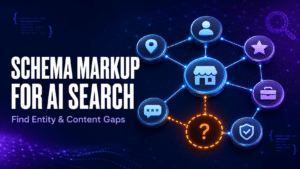
Schema markup can make relationships between the business, its services, people, locations, articles and other entities more explicit.
However, schema is not a shortcut to AI visibility. It should accurately describe information that visitors can already find on the page.
Read our guide to using schema markup to identify entity and content gaps before expanding your structured data.
How to Prioritise the Problems You Find
Do not respond to an audit by publishing a large number of new pages or adding excessive schema markup. Address the most important gaps first.
Prioritise issues using three questions:
- Is the information commercially important? Concentrate on facts that influence whether someone can find, understand or choose the business.
- Is the information wrong or merely incomplete? Incorrect addresses, services or affiliations should be corrected before creating new content.
- Can the claim be supported? Strengthen the evidence before making a bigger claim across the website.
Common high-priority actions include:
- Correcting inconsistent business details.
- Clarifying the main services and geographical coverage.
- Improving weak About and team pages.
- Publishing genuine case studies.
- Adding qualifications and accreditations with supporting details.
- Improving Google Business Profile categories and services.
- Earning relevant third-party coverage and mentions.
- Connecting related service, location and case-study pages.
- Adding accurate Organisation, LocalBusiness, Person, Service or Article schema where appropriate.
Example: A Local Plumbing Company
Imagine an AI platform is asked:
Which plumber in Preston installs combi boilers, is Gas Safe registered and provides a warranty?
A plumbing company may have a boiler installation page and excellent reviews, but AI could still find important gaps:
- The service page does not clearly mention Preston.
- The Gas Safe claim cannot be verified from the information provided.
- No engineers or qualifications are identified.
- Warranty terms are not explained.
- Reviews praise the company but rarely mention boiler installations.
- No completed installations are shown.
- The Preston page does not link to the boiler service.
- Old directories display a previous telephone number.
Adding more keywords or a large block of schema would not solve all these issues.
The stronger response would be to correct the inconsistent information, expand the visible service details, identify qualified engineers, explain the warranty, publish a genuine installation case study and connect the relevant pages.
Repeat the Audit Regularly
Your AI entity footprint changes as new reviews, pages, profiles and third-party mentions appear online.
Repeat the audit periodically and after important changes such as:
- A rebrand or business name change.
- A move to a new address.
- The launch of a major service.
- Expansion into new locations.
- A merger or acquisition.
- Changes to accreditations or affiliations.
- A website redesign or migration.
Use the same core prompt and scoring method to compare results. Test several AI platforms and manually verify the evidence each time.
AI Visibility Begins with Organisational Clarity
SEO has traditionally concentrated on helping search engines understand and rank webpages. AI search introduces a wider challenge: helping systems understand the organisation behind those pages.
Your website remains central, but it does not operate in isolation. Reviews, profiles, expert content, case studies, affiliations, press coverage and structured data collectively determine how clearly your business can be interpreted.
An AI entity footprint audit helps you identify where that picture is accurate, where it is weak and where important evidence is missing.
The objective is not to manipulate an AI system into repeating marketing claims. It is to build a clear, consistent and verifiable online presence that accurately reflects the real business.
Would You Like to Know What AI Understands About Your Business?
At Augmun, we combine traditional SEO, entity analysis, content strategy, structured data and reputation signals to help businesses become easier for both search engines and AI platforms to understand.
Our AI SEO services can identify missing information, inconsistent signals and weak evidence across your wider digital presence.
Contact Augmun to discuss an AI entity footprint audit for your business.
Frequently Asked Questions
What is an AI entity footprint audit?
An AI entity footprint audit evaluates the combined online evidence that helps AI systems understand a business. It examines the website, business profiles, reviews, structured data, third-party mentions, relationships and other publicly available information.
Can an AI audit guarantee that ChatGPT or Google will recommend my business?
No. No audit or optimisation technique can guarantee inclusion in an AI-generated answer. The purpose is to make the business clearer, more consistent and better supported by reliable evidence.
Is an AI entity audit the same as an SEO audit?
No. A traditional SEO audit usually examines technical performance, content, links and search visibility. An AI entity audit considers whether all available sources collectively create a clear and credible understanding of the organisation.
Which AI platforms should I test?
Test several platforms, such as ChatGPT, Gemini, Copilot and Perplexity. Their results may differ depending on their available sources, retrieval methods, and browsing capabilities.
How often should an AI entity footprint be audited?
For most businesses, checking every three to six months is reasonable. An additional audit should be performed following a rebrand, website migration, address change, major new service or other important organisational development.
Does schema markup improve an AI entity footprint?
Accurate schema markup can help machines interpret entities and relationships described on a website. It cannot replace visible content, independent evidence or consistent business information, and it does not guarantee AI citations or recommendations.

Chris Giles Snr built his first client website in 1995 and has remained at the leading edge of web development and SEO ever since. He is a Fellow of The Chartered Institute of Marketing (FCIM).